The Role of Toys in Enhancing Cultural Understanding: Building Bridges Through Play 🌍
Table of Contents
1. Introduction: When Play Meets Culture
2. How Toys Serve as Cultural Ambassadors
3. Traditional Toys Around the World
4. Modern Toys Breaking Cultural Barriers
5. Educational Benefits of Culturally Diverse Toys
6. Choosing the Right Cultural Toys for Children
7. The Impact on Global Citizenship
8. Conclusion: Playing Our Way to Understanding
9. Frequently Asked Questions
Introduction: When Play Meets Culture 🎭
Have you ever watched a child’s eyes light up when they discover a new toy? That moment of wonder becomes even more magical when the toy opens a window to an entirely different culture. In our increasingly interconnected world, toys have evolved beyond simple entertainment—they’ve become powerful tools for fostering cultural understanding and global awareness.
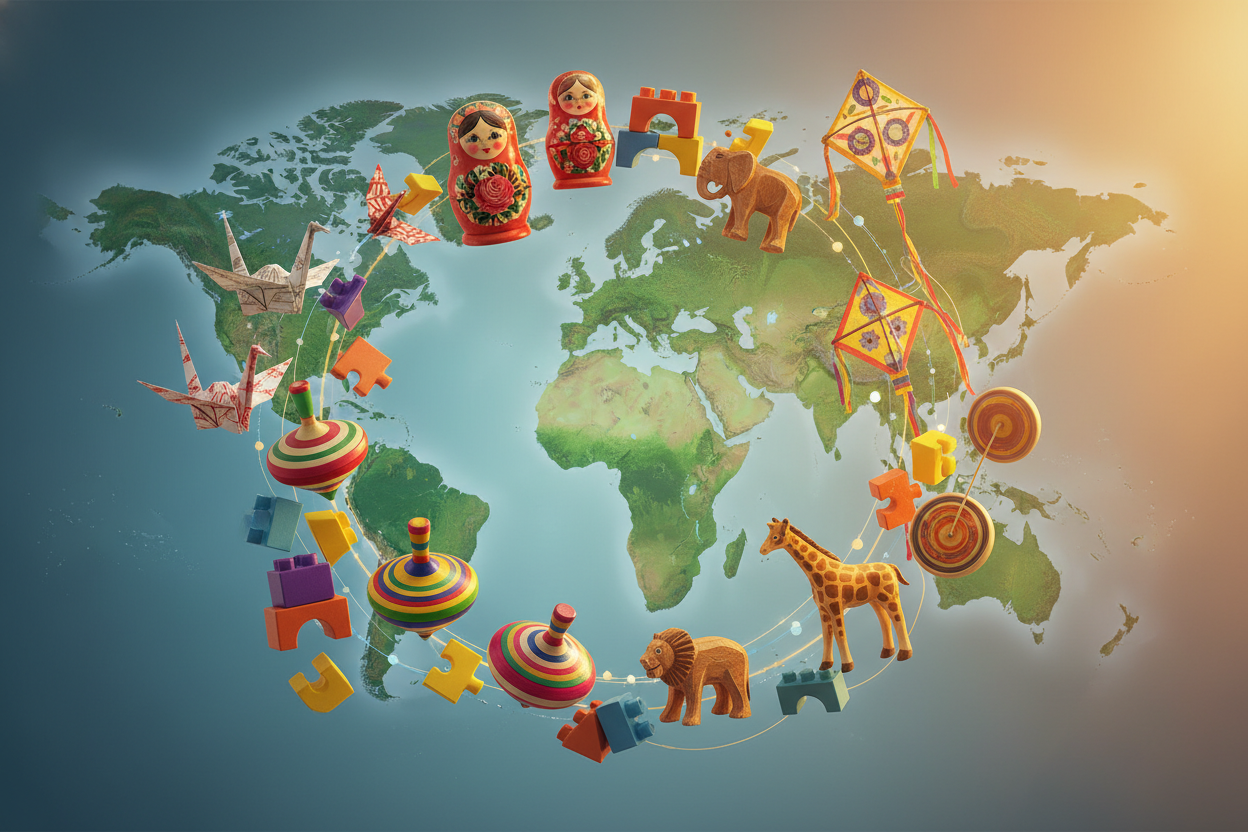
From Japanese origami sets to Mexican maracas, toys carry within them the stories, traditions, and values of their cultures. They whisper tales of distant lands, introduce unfamiliar customs, and help children develop empathy for people who might look, speak, or live differently than they do. This isn’t just child’s play; it’s the foundation for building a more understanding and inclusive world.
Today, let’s explore how toys serve as cultural bridges, connecting young minds across continents and creating tomorrow’s global citizens. Whether you’re a parent, educator, or simply someone curious about the intersection of play and culture, this journey will reveal the profound impact that thoughtfully chosen toys can have on a child’s worldview.
How Toys Serve as Cultural Ambassadors 🌏
Think of toys as tiny ambassadors, each carrying a diplomatic mission to represent their homeland. When a child plays with a set of Russian nesting dolls (matryoshka), they’re not just stacking wooden figures—they’re experiencing a piece of Russian folk art that dates back over a century. The toy becomes a conversation starter, a gateway to learning about Russian history, traditions, and artistic expression.
These cultural ambassadors work in subtle yet powerful ways. Unlike textbooks or documentaries, toys engage children through hands-on experience. A child learning about African culture through a djembe drum doesn’t just read about rhythm—they feel it in their hands, hear it with their ears, and understand it through their body. This multi-sensory approach creates lasting impressions that purely academic learning often cannot achieve.
Moreover, toys remove the intimidation factor that sometimes accompanies cultural education. When learning feels like play, children approach new cultures with curiosity rather than apprehension. They’re more likely to ask questions, make connections, and develop genuine interest in understanding differences rather than fearing them.
Traditional Toys Around the World 🪀
Every culture has contributed unique toys to the global playground, each reflecting the values, materials, and creativity of its people. Let’s take a journey around the world to discover some fascinating traditional toys and the cultural insights they offer.
In China, the diabolo—a spinning toy manipulated with sticks and string—has entertained children for over 4,000 years. This toy teaches patience, coordination, and the Chinese philosophy of balance. When children master the diabolo, they’re unknowingly practicing principles that are central to Chinese culture and martial arts.
From Peru comes the worry doll tradition, where tiny handmade dolls are said to take away children’s worries when placed under their pillows. These dolls introduce children to Guatemalan and Peruvian indigenous beliefs about community support and the power of sharing burdens—beautiful concepts that transcend cultural boundaries.
The Aboriginal Australian bullroarer, a simple wooden instrument that creates haunting sounds when spun overhead, connects children to one of the world’s oldest continuous cultures. Through this toy, children learn about the Aboriginal connection to land, spirituality, and the importance of oral traditions.
Each of these traditional toys carries DNA from its culture—the materials used, the skills required to play with them, and the stories they tell all serve as authentic cultural education tools.
Modern Toys Breaking Cultural Barriers 🚀
While traditional toys offer windows into historical cultures, modern toy manufacturers have embraced the mission of cultural education with innovative approaches. Today’s culturally diverse toys are more accessible, educational, and engaging than ever before.
Dolls representing different ethnicities have revolutionized the toy industry. When children play with dolls that look different from themselves, they naturally develop empathy and understanding. Companies like American Girl have created dolls with rich backstories from various cultures, complete with historical contexts and cultural traditions. These aren’t just toys—they’re storytelling vehicles that make history personal and relatable.
Building sets inspired by world architecture allow children to construct famous landmarks from different cultures. Whether they’re building the Taj Mahal, the Sydney Opera House, or traditional Japanese temples, children learn about architectural styles, cultural values, and historical significance while developing spatial skills and creativity.
Language-learning toys have also evolved dramatically. Interactive toys that teach basic phrases in different languages, complete with cultural context, help children understand that communication styles vary across cultures. They learn not just words, but the cultural nuances behind them.
Educational Benefits of Culturally Diverse Toys 📚
The educational impact of culturally diverse toys extends far beyond simple cultural awareness. These toys contribute to cognitive, emotional, and social development in ways that traditional educational methods often struggle to achieve.
Cognitively, children who play with culturally diverse toys develop enhanced problem-solving skills. Different cultures approach challenges differently, and toys reflecting these varied approaches expose children to multiple ways of thinking. A child playing with a Chinese tangram puzzle learns geometric concepts while also experiencing the Chinese approach to spatial reasoning and patience.
Emotionally, these toys foster empathy and emotional intelligence. When children engage with toys from different cultures, they begin to understand that there are many valid ways to live, celebrate, and express oneself. This understanding builds emotional resilience and reduces prejudice from an early age.
Socially, culturally diverse toys prepare children for our globalized world. They learn to appreciate differences rather than fear them, developing the social skills necessary for cross-cultural communication and collaboration. These children grow up more comfortable with diversity and better equipped to work in multicultural environments.
Research has shown that children exposed to cultural diversity through play demonstrate higher levels of creativity, flexibility in thinking, and openness to new experiences. These are exactly the skills needed for success in our interconnected world.
Choosing the Right Cultural Toys for Children 🎯
Selecting appropriate cultural toys requires thoughtful consideration. The goal isn’t just to collect toys from different countries, but to choose items that authentically represent cultures while being age-appropriate and engaging for the child.
First, consider authenticity. Look for toys that are either made in their country of origin or created in collaboration with cultural consultants. Avoid toys that perpetuate stereotypes or oversimplify complex cultures. A well-made set of Indian classical music instruments tells a richer story than a generic “exotic” costume.
Age-appropriateness is crucial. Younger children might benefit from simple cultural toys like musical instruments or basic puzzles, while older children can handle more complex items like traditional games with intricate rules or craft kits that require patience and skill.
Consider the learning opportunity each toy provides. The best cultural toys come with background information, stories, or activities that help children understand the cultural context. A beautiful African mask becomes much more meaningful when accompanied by information about its traditional use and cultural significance.
Don’t forget to include your child’s own culture in this diverse collection. Children need to see their own heritage represented and valued alongside others. This builds pride in their identity while fostering respect for other cultures.
The Impact on Global Citizenship 🌐
Children who grow up playing with culturally diverse toys are more likely to become global citizens—individuals who understand their connection to the wider world and feel responsibility for global issues. This isn’t an abstract concept; it’s a practical outcome with real-world implications.
These children tend to be more curious about world events, more empathetic toward people from different backgrounds, and more likely to seek out diverse perspectives. They’re less likely to develop prejudices and more likely to become advocates for equality and understanding.
In professional settings, these individuals excel in multicultural teams, demonstrate cultural sensitivity in international business, and contribute to more inclusive workplace environments. They’re the diplomats, international aid workers, global business leaders, and cross-cultural educators of tomorrow.
Perhaps most importantly, they raise the next generation with the same values of cultural understanding and global awareness, creating a positive cycle that extends far beyond their own childhood experiences with diverse toys.
Conclusion: Playing Our Way to Understanding 🤝
The humble toy, often dismissed as mere entertainment, emerges as one of our most powerful tools for building cultural understanding. Through play, children learn lessons that lectures cannot teach and develop empathy that textbooks cannot instill. They discover that differences are not threats to be feared but treasures to be celebrated.
As we face global challenges that require unprecedented cooperation and understanding, investing in cultural education through toys isn’t just nice—it’s necessary. Every culturally diverse toy we place in a child’s hands plants a seed of global citizenship that may one day bloom into solutions for our world’s most pressing problems.
The next time you’re choosing a toy for a child in your life, consider the cultural journey it might inspire. Remember that you’re not just buying entertainment; you’re potentially shaping a worldview, fostering empathy, and contributing to a more understanding world. In the simple act of play, we find one of humanity’s best hopes for a more connected and compassionate future. 🌟
Frequently Asked Questions ❓
Q: At what age should children start playing with culturally diverse toys?
A: Children can benefit from culturally diverse toys from infancy. Simple musical instruments, textured toys from different cultures, and diverse dolls are appropriate for toddlers. As children grow, they can handle more complex cultural toys and understand deeper cultural contexts.
Q: How can I ensure the cultural toys I buy are authentic and respectful?
A: Research the manufacturer and look for toys made in collaboration with cultural consultants or artisans from the represented culture. Read reviews and educational materials that accompany the toys. Avoid items that seem to stereotype or oversimplify complex cultures.
Q: Are expensive cultural toys necessary, or can I find budget-friendly options?
A: Cultural education doesn’t require expensive toys. Many meaningful cultural toys are simple and affordable—musical instruments, traditional games, craft materials, or books with cultural stories. The key is authenticity and educational value, not price.
Q: How do I explain cultural differences to young children through toys?
A: Use toys as starting points for conversations. Explain that people around the world have different ways of playing, celebrating, and creating. Emphasize similarities alongside differences, and always frame diversity as something beautiful and interesting rather than strange or wrong.
Q: Can cultural toys help children who are struggling with their own cultural identity?
A: Absolutely. Toys representing a child’s heritage can help them feel proud of their background, while exposure to other cultures shows them that diversity is normal and valued. This dual approach builds both cultural pride and global awareness.
Q: How often should I introduce new cultural toys to my child?
A: There’s no set schedule, but introducing cultural toys gradually allows children to fully explore and appreciate each one. Consider tying new toys to holidays, cultural events, or when your child shows interest in a particular culture or country.
